
Petersen Archive | Dwight D Eisenhower — Petersen Automotive Museum
[ad_1]
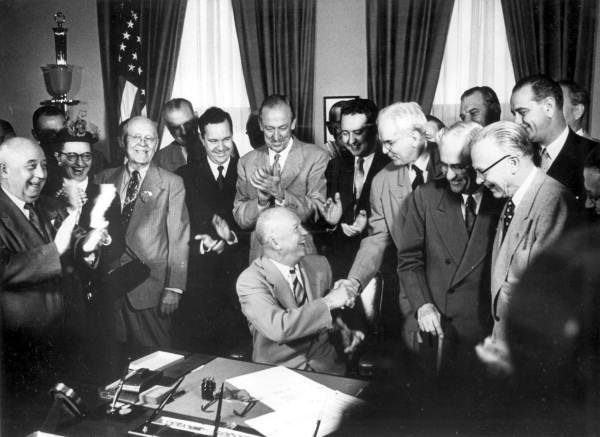
The postwar period was a time defined by unparalleled prosperity. Following the 2nd Earth War, returning GI’s came household to a booming overall economy, housing advancement projects, and help plans like the GI Invoice that expanded and cemented America’s middle course. By 1950 most factories, which includes automobile companies, had manufactured the changeover from wartime output to a client-primarily based economic climate, so much so that, in that calendar year by yourself, 8 million vehicles were being made, by 1958 additional than 67 million cars would be created and registered in the United States. Nonetheless, at the start of the ten years, most of America’s obsolete roads ended up in no issue to assist a massive inflow of visitors. Pressure for development of transcontinental superhighways experienced been rising considering the fact that the late 1930s, having said that, conflict amongst urban interests and rural pursuits vying for precedence and a absence of funding still left early initiatives such as the 1944 Federal-Assist Freeway Act dead in the h2o. By the 1950’s, in order to deal with an influx of new car or truck proprietors president Dwight D. Eisenhower publicly supported an interstate freeway improvement application and on June 29, 1956, he signed the Highway Earnings Act also acknowledged as the Countrywide Interstate and Protection Highways Act into legislation. The act marked the most significant American public performs method of that time authorizing the building of 41,000 miles of interstate highways fitted with overpasses and minimal-obtain belt lines. Eisenhower had been heavily affected by his ordeals in 1919 as a participant in the U.S. Military's to start with Transcontinental Motor Convoy across the United States and his observations of the German audubon highway network during World War II. Obtaining identified the significance of mobility and efficiency, Eisenhower proposed an American interstate freeway method in his State of the Union handle in 1954, which he framed as a national protection system. In an effort to really encourage a cooperative alliance among point out and federal officials, retired Standard Lucius D. Clay, an engineer and a extended-time advisor to the president, proposed a strategy in which the federal authorities would fork out 90 % of the value of expressway design the funding for which would occur from an increased gasoline tax (now 3 cents a gallon). Interstate resources were to then be dispersed in the ratio of each individual condition's estimated price of completing the method. The to start with challenge below the Act was the Mark Twain Expressway (Interstate 70) in St. Charles County, Missouri.
The highways were being intended to eradicate targeted visitors congestion switch “undesirable slum areas with pristine ribbons of concrete” as one freeway advocate set it make coastline-to-coastline transportation far more effective and make it straightforward to evacuate major towns in situation of an atomic attack. When transformative, the Highway Earnings Act also mirrored an enduring legacy of Jim Crow period discriminatory insurance policies and systemic racism. Low-value mortgages through the G.I. Invoice (which was not available to black GI’s), enabled white people to abandon internal towns in favor of suburban housing as well as prevent ethnic minorities from executing the identical. Federal planners of the interstate highway system routed some highways right, and usually purposefully, as a result of predominantly black and brown neighborhoods to predominantly white suburban neighborhoods. Despite the fact that the Freeway Profits Act was to begin with met with prevalent community guidance, as far more men and women turned displaced and disorders in metropolitan areas deteriorated, activists commenced to brazenly oppose the method, some likely as considerably as forcing development stoppages in the course of the late 1950s and early 60s. In the course of the 1960s, civil rights activists and environmentalists throughout the place in New York Town, Baltimore, Washington, D.C. New Orleans and other metropolitan areas managed to prevent roadbuilders from dividing and subjugating their neighborhoods, eventually nevertheless, most of the 41,000 miles of interstate were concluded.
Sources:
https://www.senate.gov/artandhistory/history/moment/Federal_Highway_Act.htm#:~:textual content=On%20June%2026%2C%201956%2C%20the,Eisenhower%20signed%20it%20into%20law.
https://www.npr.org/2021/04/07/984784455/a-transient-heritage-of-how-racism-shaped-interstate-highways
https://www.theatlantic.com/company/archive/2016/03/position-of-highways-in-american-poverty/474282/
https://highways.dot.gov/community-streets/summer-1996/federal-support-freeway-act-1956-making-interstate-system
[ad_2]
Resource link


